Quick Ref

Cognitive Distortions Cheat Sheet

A quick-reference guide to help you identify and label 10 common thinking errors that contribute to anxiety and depression.

Anxiety & Worry
Beginner
Quick Ref

Cognitive distortions are biased or irrational thought patterns that reinforce negative emotions and keep us stuck in cycles of anxiety or depression. When we are under stress, our brain often takes mental shortcuts that lead to inaccurate interpretations of reality. These "thinking traps" can make manageable problems seem insurmountable and skew our perception of ourselves, others, and the future. Understanding these patterns is the first step toward breaking free from their influence.

This cheat sheet serves as a quick-reference guide for the 10 classic distortions established in Cognitive Behavioral Therapy by pioneers like Dr. Aaron Beck and Dr. David Burns. It includes common errors such as catastrophizing, all-or-nothing thinking, emotional reasoning, and labeling. Having these definitions handy allows you to quickly recognize when your mind is drifting away from objective facts and toward unhelpful, biased conclusions.

For the best results, use this reference card alongside your 7-Column Thought Record or other cognitive restructuring tools. When you catch an automatic thought, scan this list to see which "thinking trap" it falls into. By naming the specific distortion, you gain immediate psychological distance from the thought, making it much easier to challenge with balanced evidence. Consistent practice helps rewire your brain to naturally adopt more flexible and realistic perspectives over time.
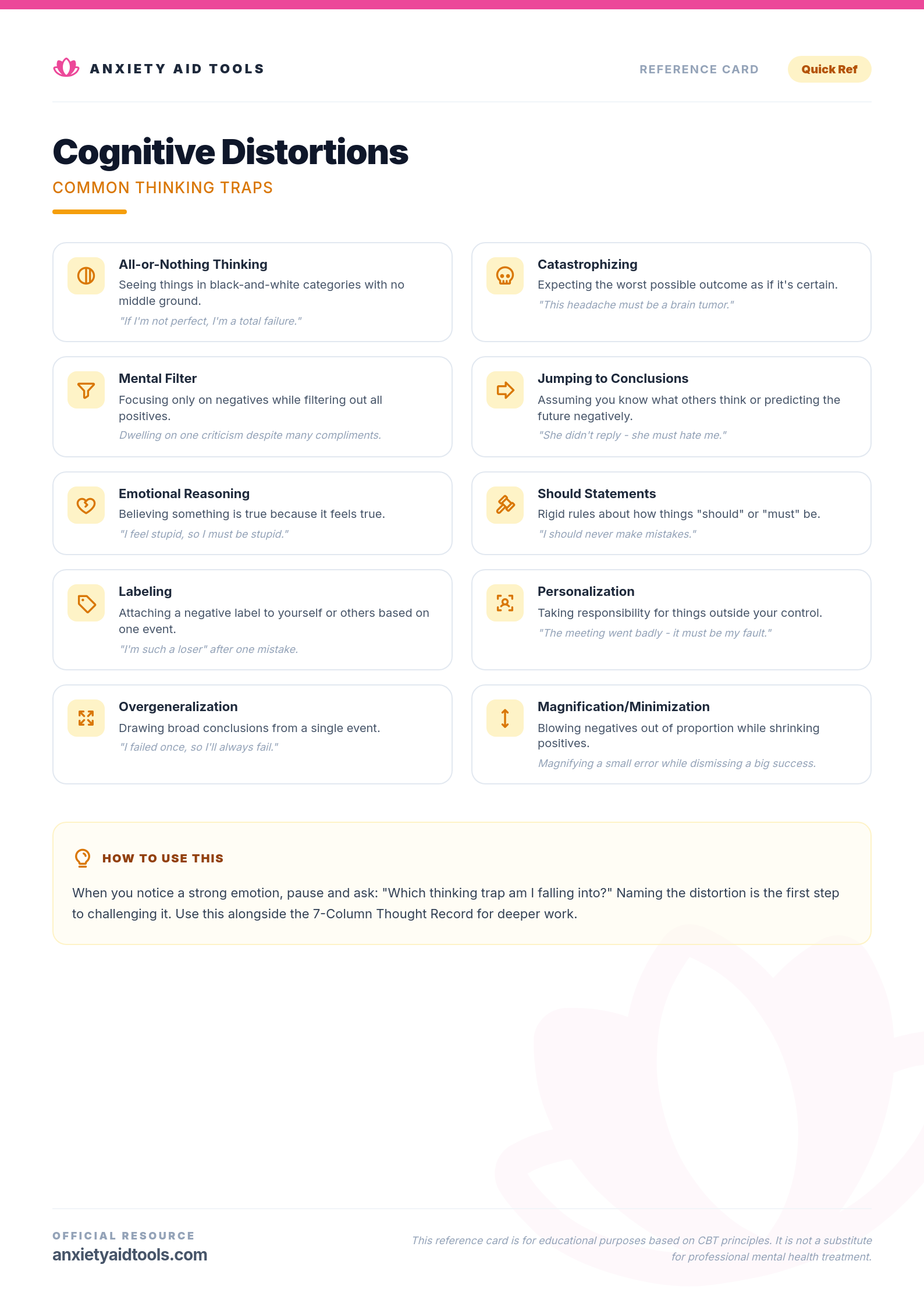
Cognitive Distortions Cheat Sheet

Cognitive Distortions Cheat Sheet

A quick-reference guide to help you identify and label 10 common thinking errors that contribute to anxiety and depression.

When to Use

  • When completing a CBT Thought Record exercise
  • To identify thinking traps during stressful moments
  • When you feel irrationally upset or overwhelmed
  • During therapy to label automatic thoughts accurately

How to Use

  1. 1
    Keep the sheet handy in your pocket or on your desk while practicing cognitive restructuring.
  2. 2
    Identify a specific thought that is currently causing you significant emotional distress or worry.
  3. 3
    Compare the identified thought against the 10 listed cognitive distortions to find a match.
  4. 4
    Label the distortion explicitly to gain psychological distance from the unhelpful thinking pattern.
  5. 5
    Generate a balanced alternative perspective based on objective evidence rather than emotional reasoning.
  6. 6
    Repeat this labeling process consistently whenever you notice your mood dropping or anxiety spiking.

Research & References

  • Burns, D. D. (1980). Feeling Good: The New Mood Therapy. William Morrow and Company.
  • Beck, A. T. (1976). Cognitive Therapy and the Emotional Disorders. International Universities Press.