15 min

Window of Tolerance

Understand your nervous system's capacity to handle stress and learn to stay within your optimal zone of arousal.

Trauma & Triggers
Beginner
15 min

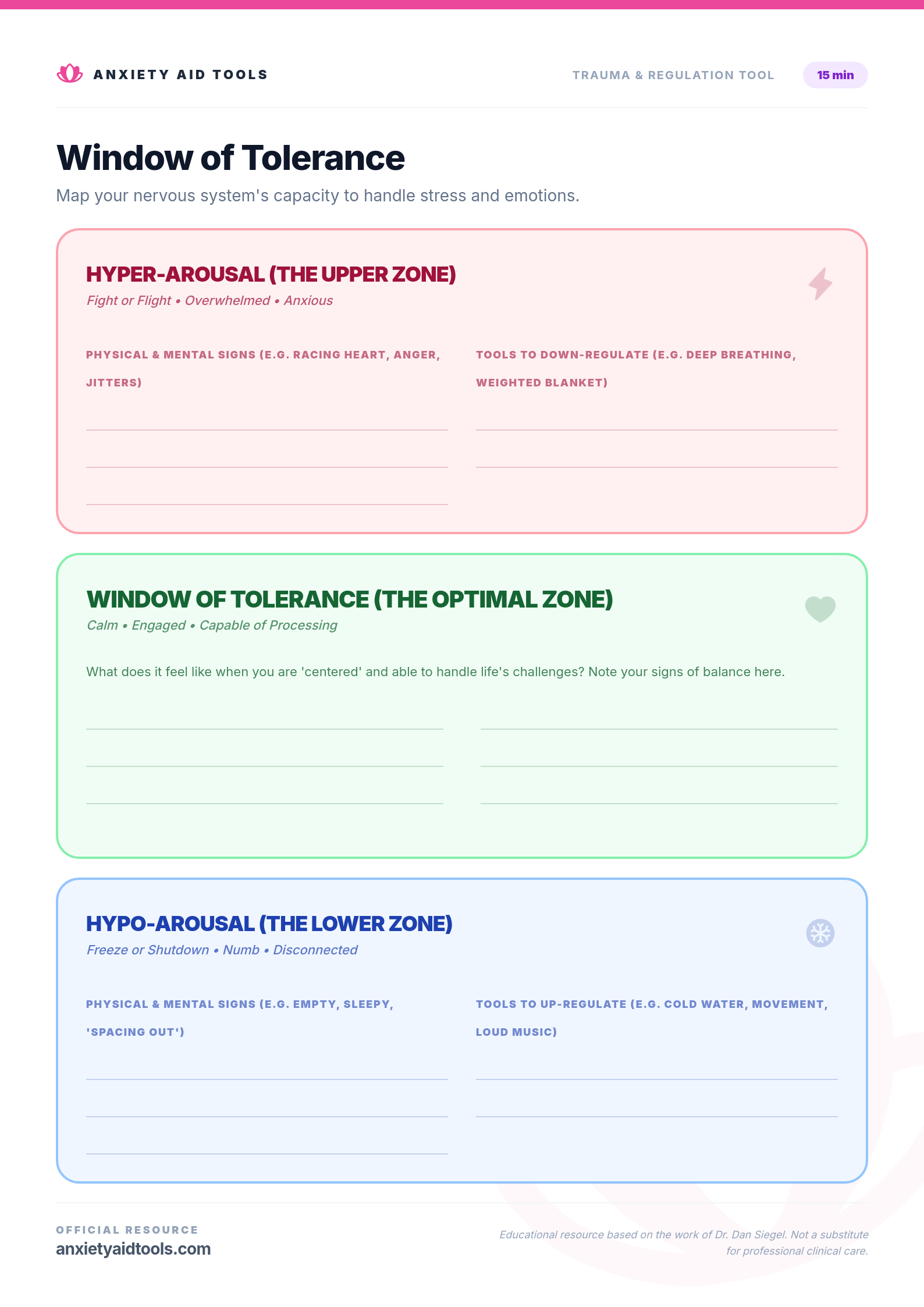
The Window of Tolerance is a concept developed by Dr. Dan Siegel to describe the optimal zone of "arousal" in which we can function and thrive. When we are within this window, we can process emotions, learn, and relate to others effectively without being overwhelmed.

Outside this window, we enter survival modes. Hyper-arousal is the "fight or flight" response—feeling overwhelmed, anxious, or angry. Hypo-arousal is the "freeze" response—feeling numb, disconnected, or exhausted. This worksheet helps you map your unique signs for each zone.

By identifying your personal triggers and symptoms, you can catch dysregulation early. Our Window of Tolerance worksheet provides dedicated space to list the specific tools that help you move back toward your center, whether you need to "down-regulate" from anxiety or "up-regulate" from numbness.
Window of Tolerance

Window of Tolerance

Understand your nervous system's capacity to handle stress and learn to stay within your optimal zone of arousal.

When to Use

  • When feeling overwhelmed or "jittery"
  • When feeling numb, shut down, or empty
  • After a stressful or triggering event
  • To track emotional regulation patterns over time

How to Use

  1. 1
    Identify Upper Signs: List the physical and mental signs of your Hyper-arousal zone.
  2. 2
    Define Your Center: Note what it feels like to be in your Optimal Zone (The Window).
  3. 3
    Identify Lower Signs: List the signs of your Hypo-arousal zone (freeze/numbness).
  4. 4
    List Your Tools: Document the specific skills that help you return to your center.
  5. 5
    Daily Check-ins: Practice identifying which zone you are in throughout the day.
  6. 6
    Early Intervention: Apply your tools as soon as you notice yourself drifting out of the window.

Research & References

  • Siegel, D. J. (1999). The Developing Mind. Guilford Press.
  • Ogden, P., Minton, K., & Pain, C. (2006). Trauma and the Body: A Sensorimotor Approach to Psychotherapy. W. W. Norton & Company.