10 min

The Worry Tree

A powerful flowchart to distinguish between actionable and hypothetical worries.

Anxiety & Worry
Beginner
10 min

The Worry Tree is a classic Cognitive Behavioral Therapy (CBT) tool used to break the cycle of unproductive overthinking. Most of us spend a significant amount of our mental energy worrying about things that haven't happened yet, or things we have absolutely no control over. This creates a state of chronic stress without providing any solutions.

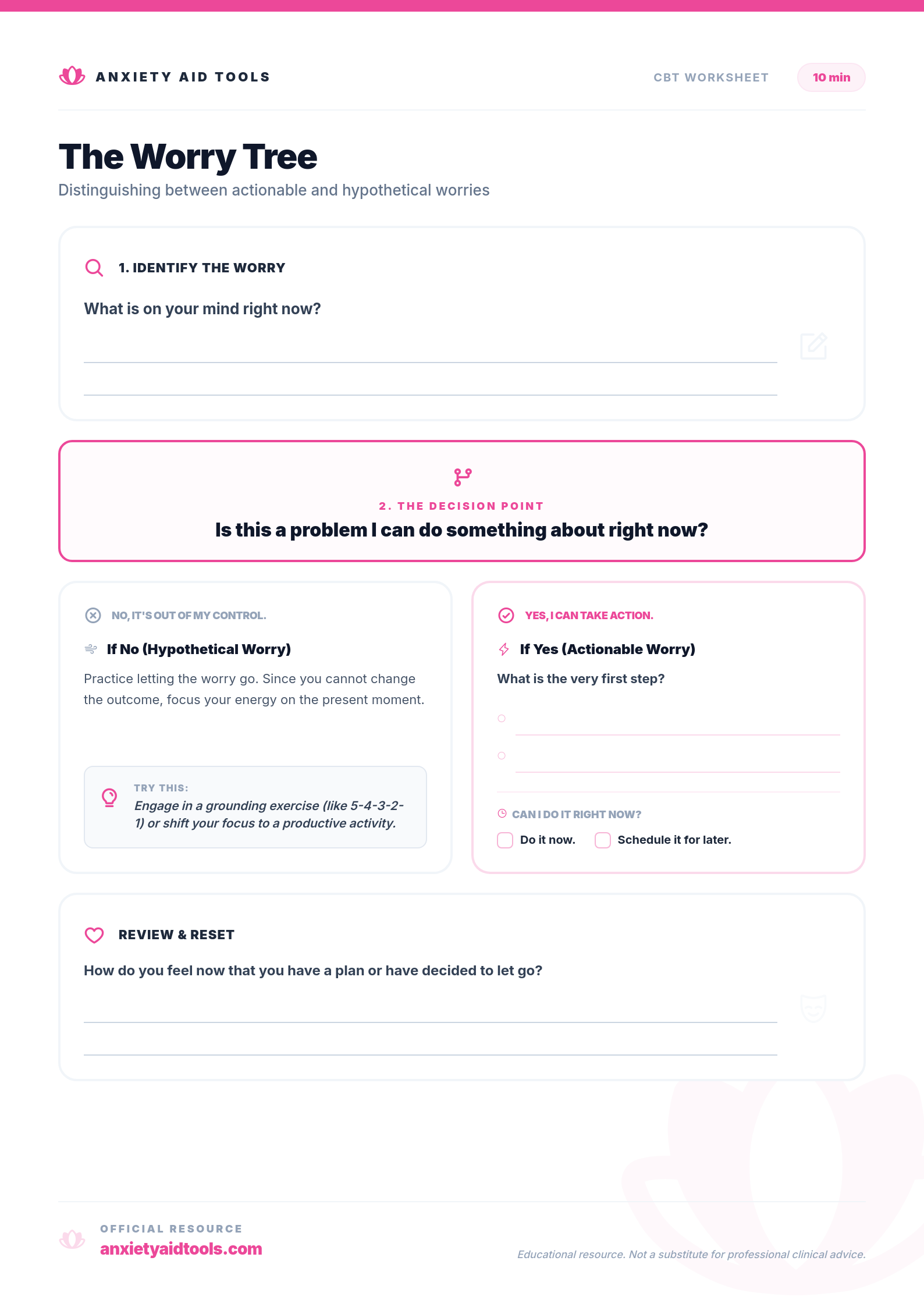
This worksheet guides you through a logical decision-making process. By asking yourself a simple question—'Is this a problem I can do something about?'—you can categorize your worries and apply the correct psychological strategy. If the answer is yes, we move into proactive planning. If it's no, we practice the art of refocusing and letting go.

Using the Worry Tree consistently helps retrain your brain to prioritize effective problem-solving over 'passive' worrying. It is particularly effective for Generalised Anxiety Disorder (GAD) and for anyone who feels overwhelmed by a long list of concerns.
The Worry Tree

The Worry Tree

A powerful flowchart to distinguish between actionable and hypothetical worries.

When to Use

  • When you feel stuck in a loop of overthinking
  • During periods of significant uncertainty
  • When a worry prevents you from concentrating
  • Before bed if worries are keeping you awake

How to Use

  1. 1
    Identify the Worry: Write down exactly what is on your mind in the first box.
  2. 2
    Ask the Key Question: Honestly assess if you can take action on this right now.
  3. 3
    If No: Follow the left path. Practice letting the worry go and use a grounding skill to return to the present.
  4. 4
    If Yes: Follow the right path. Identify the very first small step you can take.
  5. 5
    Decide on Timing: If you can do it now, do it. If not, schedule a specific time to handle it.
  6. 6
    Reflect: Notice the shift in your energy once you have a clear plan or have decided to release the concern.

Research & References

  • Butler, G., & Hope, T. (1995). Manage Your Mind: The Mental Fitness Guide. Oxford University Press.